Custom Pilates Sock Orders: Pricing, MOQs & Lead Times
A studio’s brand shows up in a lot of small places, but few are as visible, class after class, as what’s on your clients’ feet. A custom pilates sock — printed with your logo, dyed in your studio colors, or molded with a house grip pattern — turns a few dollars of blank inventory into retail merch people actually buy, then wear back into your lobby every week. Before you request a quote, it’s worth knowing what “custom” really costs across the industry: how order size changes your price per pair, what materials show up in a decent sock, and how long production takes once you sign off on a sample.
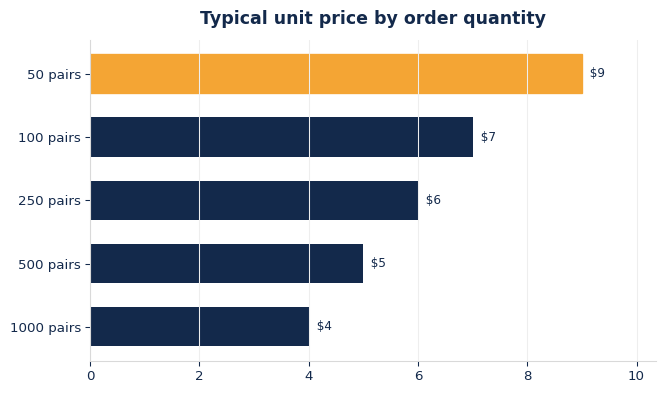
The range is wider than most first-time buyers expect. You can walk out with two dozen unbranded pairs from a stock supplier this week, or commit to 5,000 pairs of a fully tooled, factory-direct design with an eight-to-ten-week runway. The figures below come from current wholesale and manufacturer pricing pages so you can budget accurately instead of guessing.
Source: deadsoxy.com wholesale and custom sock guides (2026)
What actually makes a sock a custom pilates sock
Two things separate a custom pilates sock from a plain grip sock pulled off a shelf: the fabric blend it’s knit from, and where the manufacturer places the silicone grip. Both affect comfort, durability, and price, and both are worth specifying explicitly in your quote request rather than leaving to the factory’s default.
Fiber blend and feel
Most grip socks on the market are knit from a cotton-nylon-spandex blend, though the ratios vary a fair amount by supplier. Common compositions include roughly 55% cotton, 40% nylon, and 5% spandex; a looser 75–80% combed cotton with 15–20% polyester and nylon and 3–5% spandex; and a firmer 72% cotton, 18% polyester, 8% nylon, 2% elastane mix. Premium programs sometimes swap in organic cotton, landing around 65% organic cotton, 30% nylon, 5% spandex. Higher cotton content generally feels softer against skin and breathes better; higher nylon and spandex content holds shape through more wash cycles and grips the foot more securely inside a shoe or reformer strap. If you’re ordering for a studio that runs hot, heavy classes, ask your supplier for the exact percentage breakdown before approving a sample — it matters more to repeat customers than the print on top.
Where the grip goes
Silicone application comes in two basic layouts. Full-sole coverage runs silicone across the entire bottom of the foot, which maximizes traction on a reformer carriage or mat but can trap heat and reduce breathability over a long class. Targeted-zone grip places silicone only at the ball of the foot, heel, and toes, leaving the arch uncoated for airflow while still covering the contact points that matter for stability. Reputable suppliers rate their silicone dots to survive 50 or more machine washes without peeling or cracking, which is a fair benchmark to hold a new vendor to before you commit to a bulk order.
MOQs and lead times by customization type
Minimum order quantity is the single biggest lever on both price and timeline, and it moves in fairly predictable steps depending on how the branding is applied. A logo screen-printed or heat-transferred onto an existing sock body is the cheapest and fastest path to a branded product. A logo knit directly into the fabric during production costs more per unit but holds up better long-term. A custom grip pattern molded into the silicone sole itself requires its own tooling, which is where minimums jump sharply.
| Customization type | MOQ (pairs) | Lead time after sample approval |
|---|---|---|
| Stock, no branding | 24–50 | Ships from existing inventory |
| Logo print on sock body | 100–200 | 3–4 weeks |
| Custom molded grip pattern | 500–1,000 | 5–6 weeks |
| Factory-direct full custom | 5,000 | Full order 8–10 weeks |
How long production actually takes
Plan backward from your launch date, not forward from the day you place an order. Suppliers typically need a deposit before they’ll cut a physical sample, and that sample itself takes about two weeks to arrive. Only after you approve it does the factory schedule mass production, and that stage is where the branding method matters again: standard logo-print runs move fastest, while a custom molded grip sole adds real time because the mold has to be cut and tested before full runs start. Add shipping and customs clearance on top of production, and a fully custom order commonly lands at eight to ten weeks door to door.
If you’re planning a seasonal launch, a studio opening, or a holiday retail push, work backward from that date and add a buffer — sample revisions are common on a first order, and each round adds roughly two weeks.
Logo print vs. knit-in vs. molded grip: which branding to choose
For a first order, logo print on an existing sock body is the least risky choice. It has the lowest MOQ of the three custom options (100–200 pairs), the shortest lead time, and lets you test whether your clients actually buy branded socks before you sink money into anything more permanent. The tradeoff is durability: printed logos can fade or crack faster than knit-in branding, especially on the sole where friction is highest.
Knit-in branding, where the logo is built into the fabric during the knitting process rather than applied afterward, costs more per pair — pricing around $5.27 per pair at a 100-pair minimum is typical for this method — but the logo won’t peel, crack, or fade the way a printed one can. It’s the better choice once you know a design is a keeper and you’re placing a repeat order.
A custom grip pattern molded into the silicone sole itself is the most distinctive option and the one most likely to be recognized as “your” sock rather than a generic printed one, but it requires dedicated tooling. That’s why MOQs jump to 500–1,000 pairs and lead times stretch to five or six weeks for production alone. Reserve this route for a design you’re confident will sell in volume, or for a flagship product rather than a first test order.
Budgeting for your first order
Wholesale pricing for a custom pilates sock generally falls between $2.50 and $6.00 per pair, with the exact number depending on grip coverage (full-sole costs more in silicone than targeted-zone), fabric blend, and how many colors your print or knit-in design uses. Studios ordering their first small batch of 100–200 printed pairs should expect to land toward the middle or upper end of that range; per-pair cost tends to drop as order size climbs into the thousands, since tooling and setup costs get spread across more units.
A few practical budgeting notes worth flagging before you request quotes:
- Most manufacturers require a deposit before cutting a sample, and the sample itself is a separate line item from the bulk order — ask upfront whether sample cost is credited against your production order.
- Sizing runs typically ship in small (women’s 5–7.5), medium (women’s 8–10 / men’s 7–9), and large (men’s 9.5+), so budget for a size curve rather than one flat quantity if you’re selling retail rather than handing socks out as class freebies.
- If you’re testing demand, the 100–200 pair logo-print tier is the standard entry point industry-wide — it’s low enough to limit risk but high enough that most factories will quote it without a rush surcharge.
Frequently asked questions
What’s the minimum order for a custom pilates sock?
It depends on how the branding is applied. Stock socks with no customization can sometimes be ordered in quantities as low as 24–50 pairs. A logo printed on the sock body typically starts at 100–200 pairs. A custom grip pattern molded into the sole usually requires 500–1,000 pairs because of the tooling involved, and some factory-direct programs set minimums as high as 5,000 pairs per design.
How much does a custom pilates sock cost per pair?
Wholesale pricing generally runs $2.50 to $6.00 per pair depending on grip coverage and customization level. Knit-in logo programs, where the branding is built into the fabric rather than printed on, commonly start around $5.27 per pair at a 100-pair minimum. Price per pair typically drops as order size increases.
What material is best for pilates grip socks?
Most grip socks use a cotton-nylon-spandex blend, with cotton content anywhere from about 55% up to 80% depending on the supplier, plus nylon or polyester and a small amount of spandex or elastane for stretch. Higher cotton content feels softer and breathes better; higher synthetic content holds its shape and grip through more wash cycles. Premium options sometimes use organic cotton blends.
How long does it take to get a custom order made?
Expect about two weeks for sample development after your deposit, then 3–4 additional weeks for a standard logo-print production run or 5–6 weeks if you’re molding a custom grip pattern into the sole. Including shipping, a fully custom order typically lands 8–10 weeks after you approve the sample.
Should I choose full-sole grip or targeted-zone grip?
Full-sole silicone gives maximum traction across the entire foot, which suits high-intensity reformer or mat work but reduces breathability over a long class. Targeted-zone grip covers only the ball of the foot, heel, and toes, leaving the arch open for airflow while still covering the main contact points. Studios running back-to-back classes often prefer targeted-zone grip for comfort; studios prioritizing maximum stability tend to choose full-sole.
Can I order a sample before committing to a full production run?
Yes, and it’s standard practice. Most manufacturers require a deposit to cut a physical sample, which takes roughly two weeks to produce and ship. Ask whether the sample cost is credited toward your bulk production order — many suppliers apply it once you place the full order.
The bottom line
Ordering a custom pilates sock comes down to matching your branding method to your order size and timeline. A printed logo on 100–200 pairs is the low-risk way to test whether your clients will buy studio-branded socks, with production wrapped up in about a month. Once you know the design works, knit-in branding or a fully molded grip sole are the upgrades worth the higher minimums and longer lead times. Either way, build your timeline backward from launch day — between sampling, production, and shipping, a fully custom order can easily take two to two-and-a-half months from deposit to delivery.