Silicone or PVC? What the Grip on a Studio Sock Is Really Made Of
The sock is just a carrier. What a member actually pays for on a grip sock is the pattern of compound printed across the sole, and that compound is where the meaningful differences between one studio sock and another live. Two socks knitted from identical combed cotton can behave completely differently on a reformer rail depending on what the grip is made of and how it was applied. If you stock or brand socks for a studio, it is worth understanding that layer in its own right.
The compound underfoot: silicone, PVC, and rubber
Three materials cover almost every grip sock on the market. PVC, often called plastisol, is the budget standard: it is printed as a paste and cured with heat, it grips adequately, and it keeps the sock cheap. On a smooth floor its coefficient of friction sits in roughly the 0.5 to 0.8 range. Silicone is the premium option, with friction figures around 0.8 to 1.2, meaning it bites harder on a polished studio floor. Natural rubber lands in between at about 0.7 to 1.0 but is more sensitive to heat and ages faster. Those friction numbers are indicative laboratory-style figures rather than guarantees, but the ranking is consistent across sources.
Silicone also tolerates a far wider temperature band, holding up from deep cold to well above boiling, where PVC starts to soften around 70 degrees Celsius. That matters less for the floor and more for the laundry, because it is what lets silicone survive repeated washing that would slowly flatten a PVC print.
How the grip is applied, and why it decides lifespan
Material is only half the story; application method is the other half. A screen-printed grip lays the compound on thin and flat, which is cheap and comfortable but wears through soonest. An injection-molded or three-dimensional grip builds the dots up with more material and more surface area, so it lasts noticeably longer. Heat-transfer grips sit in the middle. This is why two silicone socks can differ: a thin screen print of good silicone can still wear out before a chunky molded PVC dot.
Hardness is the specification most buyers never see but can feel. Grip compound is usually formulated to a Shore A hardness of roughly 20 to 40. Softer than about 15 and the dots deform and feel mushy underfoot; harder than about 50 and they feel like sitting on gravel and grip less because they cannot conform to the floor. When a sample feels either slippery-hard or squashy, hardness is usually the reason.
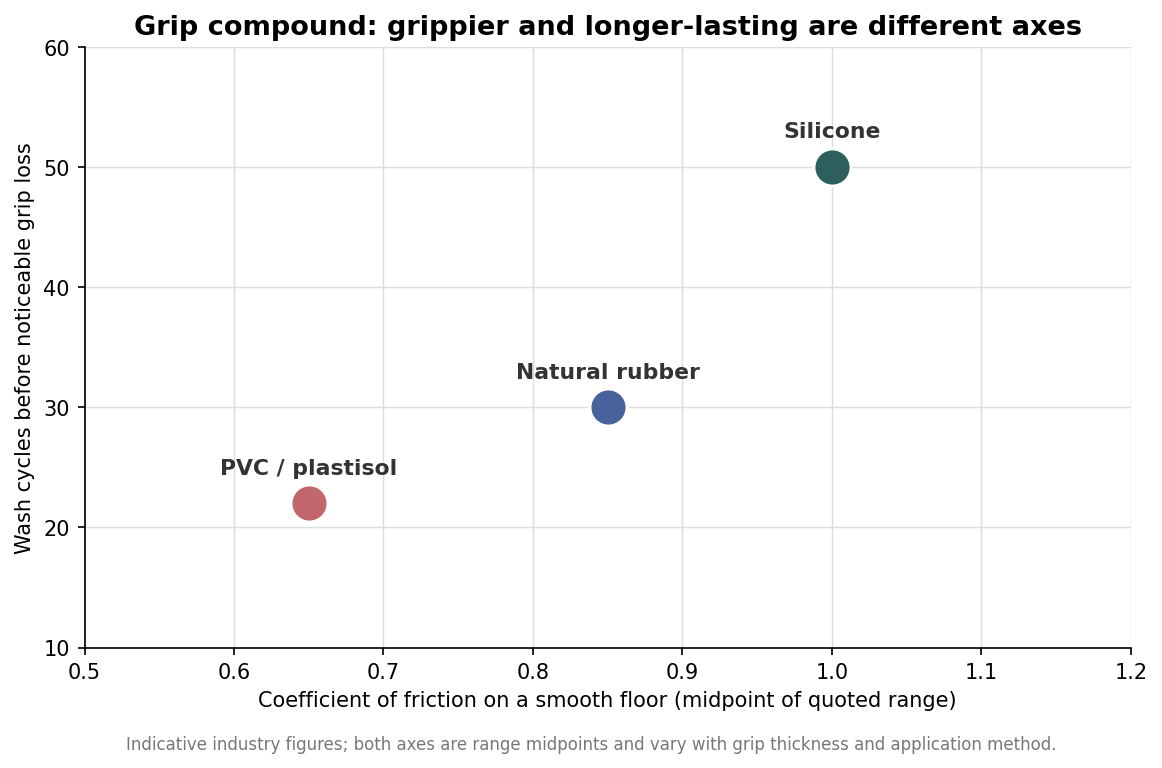
The chart makes the key point plain: grippier and longer-lasting are not the same axis. Silicone happens to do well on both, which is most of why it commands a manufacturing premium of roughly 30 to 40 percent over PVC. Whether that premium is worth paying depends entirely on how the socks are used and how often they are washed.
How long the grip actually lasts
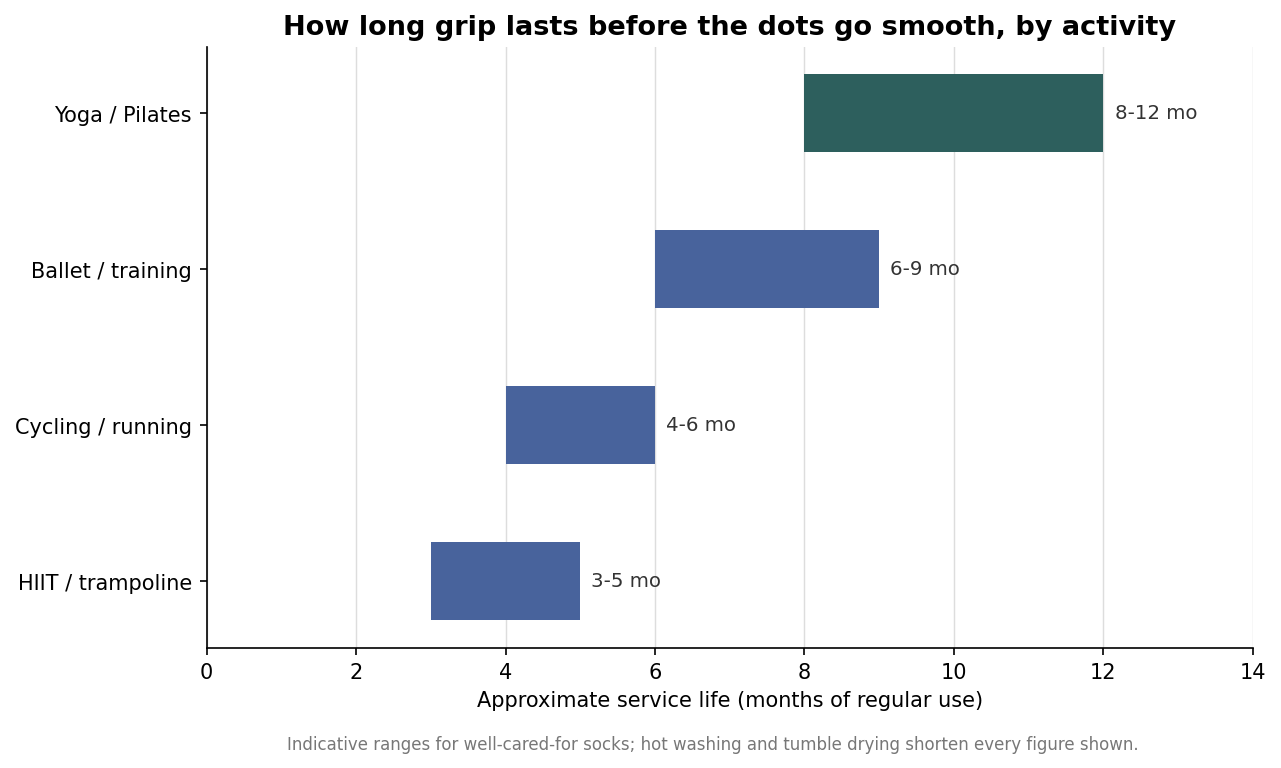
Grip does not fail suddenly; the dots gradually go smooth until the sock starts to slip, and that point arrives faster with abrasive, high-impact movement. As a rough guide, well-cared-for socks used a couple of times a week last around eight to twelve months for yoga and Pilates, six to nine months for ballet and general training, four to six months for cycling and running, and only three to five months for HIIT or trampoline work where the feet drag and pivot constantly.
Measured in wash cycles rather than months, the material gap is stark: silicone often survives fifty or more washes with minimal degradation, while PVC typically shows noticeable loss somewhere between fifteen and thirty. For a studio member doing two gentle Pilates classes a week, a PVC sock may last a full season and cost less per wear; for someone training hard several times a week and washing after every session, silicone usually wins on cost per wear despite the higher sticker price.
Care that protects the grip
Most premature grip failure is a laundry problem, not a manufacturing one. Heat is the enemy of every grip compound, so the reliable advice is a cold, gentle wash and air drying, ideally with the socks turned inside out so the dots are not abraded against the drum. Fabric softener is worth avoiding because it can leave a film that reduces tack, and bleach degrades both the yarn and the compound. A tumble dryer will shorten every lifespan figure above, sometimes dramatically, which is why studios that fold care instructions into the packaging tend to see fewer complaints about socks going slippery early.
Specifying the grip for a custom studio sock
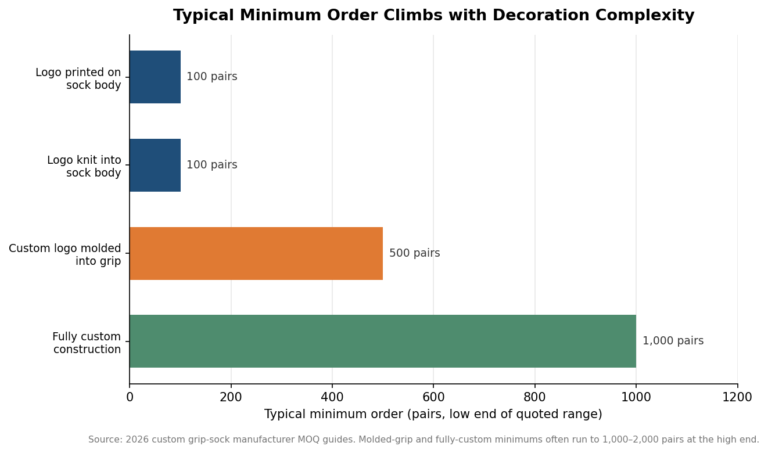
When you brief a custom run, treat the grip as a line item with its own decisions rather than accepting a default. Match the compound to the class mix: silicone for high-frequency, high-intensity or hot-room studios where wash durability pays for itself, PVC for gentler or price-sensitive retail where a lower price point sells more pairs. Ask whether the grip is screen-printed or built up, because that quietly determines how many months the sock stays safe. Confirm the hardness sits in that comfortable middle band, and if the socks carry a logo on the sole, keep it clear of the main weight-bearing zones so branding does not interfere with grip or wear away first. Getting those specifics into the brief turns grip from an afterthought into the part of the sock that actually earns the reorder.