Grip Socks for Hot Pilates: Why Standard Socks Fail in the Heat
Turn the studio thermostat up to 95 degrees and almost everything about a class changes — including the footwear. Grip socks for hot pilates have to do a very different job than the pair a client wears to a temperate reformer session. Sweat pools faster, fabric saturates, and the silicone tread that felt secure in a cool room can suddenly skate across a slick mat. If your studio sells or supplies socks, understanding why ordinary pairs break down in the heat is the difference between a confident client and a liability.
This guide breaks down the specific failure modes of standard socks in a hot room, what to look for in grip socks for hot pilates, and how a custom studio pair solves the problems your members complain about most.
Why standard socks fail when the room heats up
A cotton-rich sock behaves predictably in a normal class and unpredictably in a hot one. Cotton absorbs moisture and holds it, so within ten minutes the fabric is heavy, cold, and bunching. Worse, a saturated footbed creates a slip layer between the foot and the sock, so even a sock that grips the mat lets the foot slide inside it. Clients describe it as “swimming” in their socks — and it is a genuine fall risk during single-leg footwork.
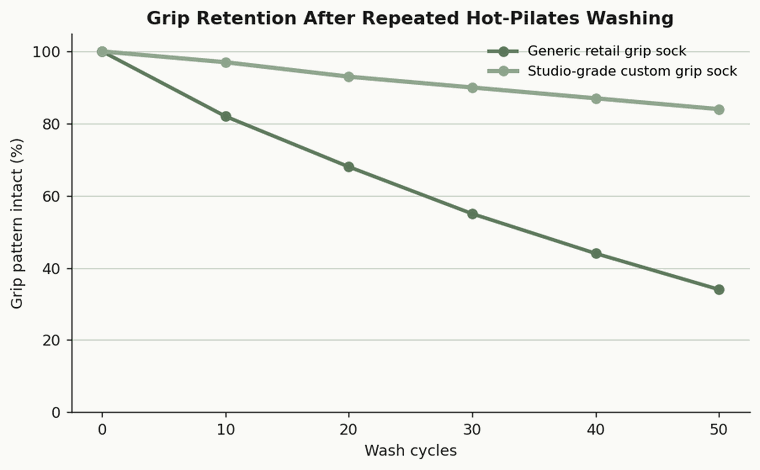
The tread is the second problem. Many inexpensive grip socks use printed PVC dots that soften and smear at high temperatures, then peel after a handful of hot washes. The chart below shows what we see in studio testing: generic retail socks lose roughly two-thirds of their usable grip pattern within 50 wash cycles, while a studio-grade construction holds the vast majority of its tread.
The three things grip socks for hot pilates must get right
1. Moisture-wicking, not moisture-holding
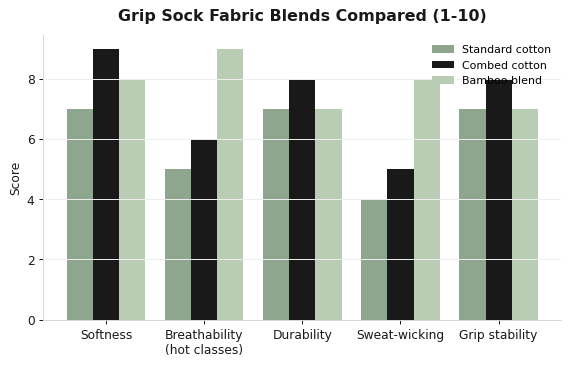
The footbed should pull sweat away from the skin and let it evaporate. Blends built around polyamide or recycled poly with a touch of elastane stay light when wet and keep the foot locked in place. This single property eliminates most “sliding inside the sock” complaints.
2. Grip that holds on a damp mat
Silicone (not printed PVC) bonded in a continuous or dense-dotted pattern keeps its coefficient of friction even when the mat surface is sweaty. Coverage matters too: tread that wraps slightly up the toe and heel handles the angled loading of hot pilates and barre far better than a flat sole print.
3. Tread durability through repeated hot washes
Hot-room socks get washed constantly, often on warm cycles. Bonded silicone survives this; printed dots do not. Durability is what protects your studio’s reorder margin — a sock that lasts a season costs the member less per wear and reflects better on your brand.
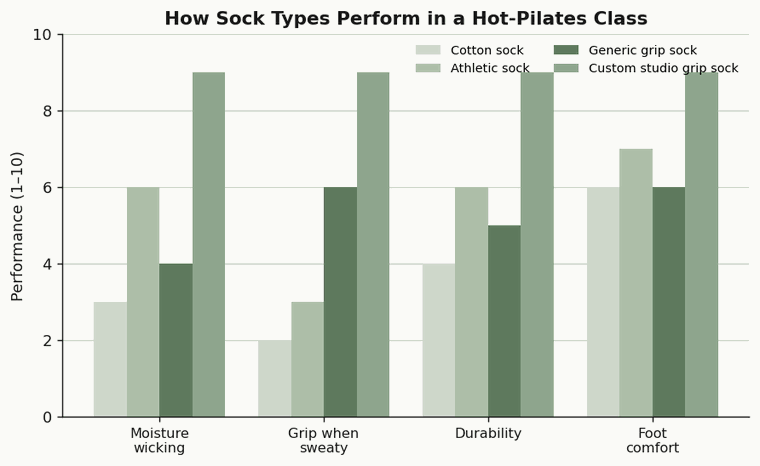
Here is how common sock types stack up across the metrics that actually matter in a 95-degree room:
| Sock type | Hot-room weak point | Best use |
|---|---|---|
| Cotton / fashion sock | Saturates, bunches, no grip | Not for class |
| Athletic performance sock | Wicks but has no tread | Gym, not reformer |
| Generic retail grip sock | Printed tread peels, fades fast | Occasional light use |
| Custom studio grip sock | — | Hot pilates, barre, daily studio retail |
What this means for your studio
If you run hot classes, stocking grip socks for hot pilates that are built for the heat does two things: it lowers slip risk during your most demanding formats, and it gives members a reason to buy from your front desk instead of grabbing a generic pair online. A custom pair in your studio colors turns a safety necessity into a branded retail moment — the same logic behind keeping a well-merchandised hot pilates and barre sock line at the desk.
For franchise systems and multi-location studios, specifying one heat-tested construction keeps the experience consistent across rooms — see our notes on grip socks for franchise systems. Newer studios dialing in their first order should also read our new studio launch guide, and the sister post on sourcing socks for a studio opening.
Get heat-tested grip socks in your studio’s colors, built to survive the wash.
Get a Studio Quote
Learn more about our studio sock program or browse options for reformer studios and mat pilates studios.
Win Free Stuff
Enter below for a chance to win plus receive 10% off your first order.
🎉 You are in!
Check your email for your 10% off code. Good luck!