How to Spec a Custom Grip Sock Order: Needle Count, Grip Layout, and Decoration
Most studios order their first run of custom grip socks the same way they buy retail: pick a color, drop in a logo, approve a mockup. Then the samples arrive knitted too thin, the logo looks fuzzy on the sole, and the grip wears smooth after a season of hot classes. Speccing a grip sock is closer to speccing a printed sign than picking a t-shirt color. A handful of construction decisions, made in the right order, determine how the sock feels, how the branding reads, and what you pay per pair. Here is the order to make them in.
Start with needle count, because it sets everything downstream
Needle count is the number of stitches around the sock tube, and it is the single spec that quietly governs fabric density, logo clarity, and cost. The everyday athletic standard is 144N, which balances a reasonable thickness with clean, blocky pattern work. Step up to 168N for finer fashion and dress socks, and 200N is where high-end socks with fine text and intricate logos live. Thicker winter and slipper constructions drop down to 96N or 108N. Higher counts require finer yarn, knit more slowly, and cost more per pair, so the number is a budget decision as much as a look decision.
Let your logo drive the count. A simple mark, block colors, or bold text generally reads cleanly at 144N. A medium-complexity logo with some gradient or smaller lettering is safer at 168N. Fine text, thin linework, or a detailed emblem needs 200N as a practical minimum, because below that the knit simply cannot resolve the detail and your artwork turns to mush on the fabric. If your brand mark is delicate, decide that here, before you fall in love with a mockup a 144N machine can never reproduce.
Choose your grip layout and formulation before your artwork
Grip coverage comes in two broad layouts. A full-sole grip puts silicone across the whole underfoot for broad, stable traction that holds across changing foot positions, which is why it tends to win for reformer and mat stability. A half-sole grip concentrates material at the heel and forefoot, the high-pressure zones, and leaves the midfoot more flexible for sport-style movement. Neither is universally better; the right one depends on whether your classes prize planted stability or responsive flex.
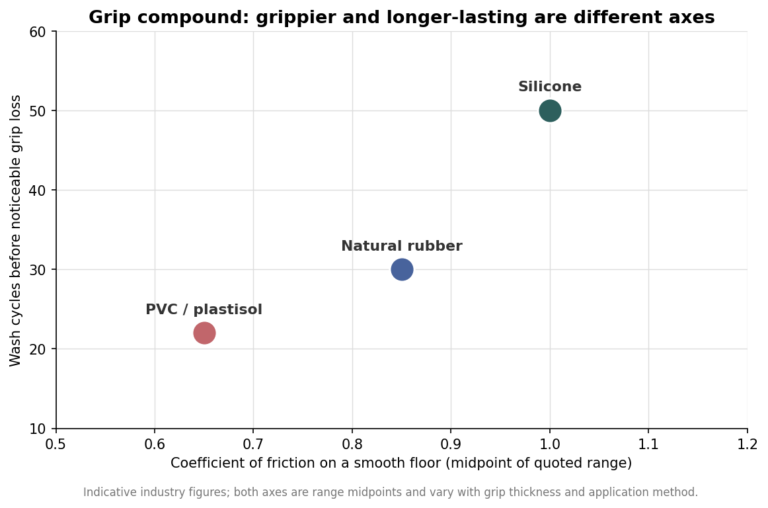
The formulation matters more than the photo. Two grip socks can look identical in a product shot and behave completely differently after twenty washes, because the silicone’s elasticity, tack, and hardness, plus the print thickness and curing profile, all vary between suppliers. When you evaluate samples, ask for the durability targets the factory builds to. Serious manufacturers cite figures like more than 50,000 abrasion cycles for high-impact use, grip that survives 100-plus wash cycles, and colorfastness at grade 4 to 5 for retail consistency. If a supplier cannot speak to any of those numbers, you are buying on looks alone.
Match the decoration method to your order size
How you brand the sock is tied directly to how many pairs you are willing to buy. The lightest-lift option is a logo printed or embroidered on the sock body, which typically opens at 100 to 200 pairs. Knitting the logo into the sock body is a step up in quality and also starts near a 100-pair minimum. Molding your logo into the grip itself, so the silicone dots form your mark, requires a custom mold and usually pushes the minimum to 500 to 1,000 pairs. Fully custom construction, where the sock is engineered to your spec end to end, generally lands between 1,000 and 2,000 pairs. The chart below shows the low end of those quoted minimums.
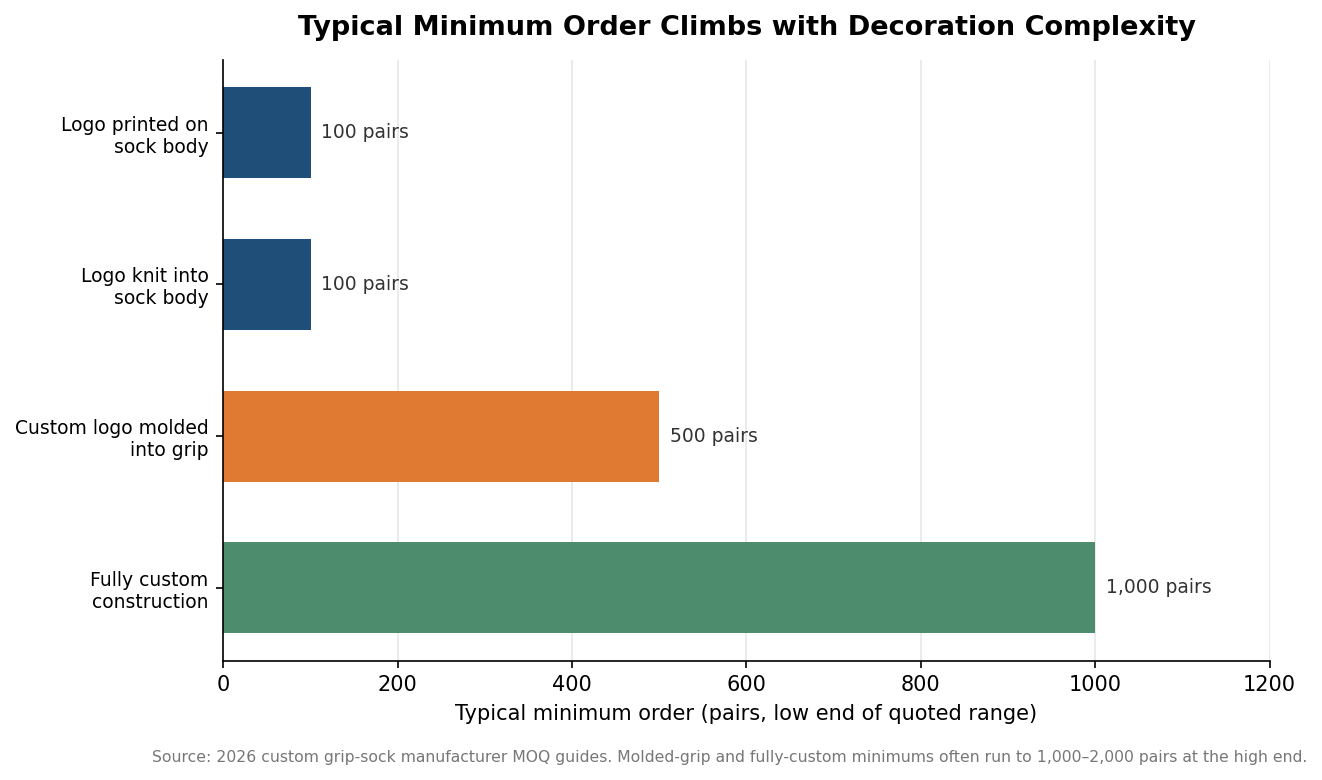
The practical read is that your branding ambition should match your inventory appetite. A new studio testing demand with 150 pairs should plan on a printed or knit-in body logo, not a molded-grip logo it cannot hit the minimum for. Save the molded grip for the reorder, once you know the size run actually sells.
Read a price quote the way a manufacturer builds it
Per-pair price is a function of quantity first, decoration second. Published 2026 wholesale guides put basic grip socks in roughly the $2.50 to $4.00 range at 100 to 499 pairs, falling toward $1.00 to $2.00 once you clear 5,000 pairs. Premium grip runs higher at every tier, and a custom logo molded into the grip carries the biggest premium, opening around $5.00 to $8.00 per pair at small volumes. Knit-in branding has been quoted from about $5.27 per pair at a 100-pair minimum. Treat every one of these as an indicative band, not a fixed price; yarn choice, needle count, and supplier all move the real number.
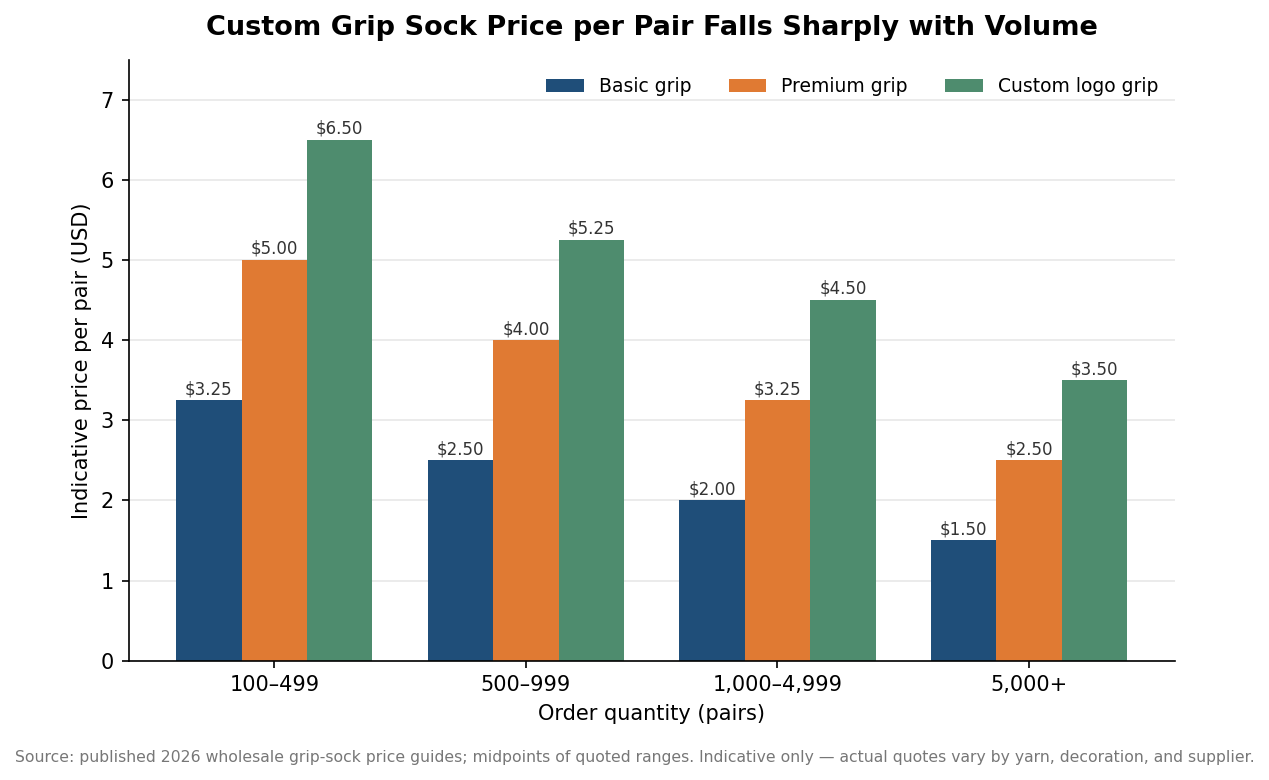
The steepness of that volume curve is the reason experienced buyers consolidate. Splitting a year into four 250-pair reorders can cost meaningfully more per pair than committing to a single 1,000-pair run and warehousing the difference, assuming your design is stable. If you are still iterating on colorways, the flexibility of small runs is worth the premium; if your design is locked, volume is the cheapest lever you have.
Build a realistic timeline from approved artwork
Custom grip sock production commonly runs 8 to 10 weeks from approved artwork to delivery, and that clock does not start until the artwork is genuinely approved, not merely sent. Sampling, revisions, and any custom mold for a grip logo sit on top of that window, and a single round of “can we make the logo bigger” can add a week or two. For a studio timing socks to a launch, a new-year retail push, or a teacher-training cohort, that means starting the conversation two to three months ahead and freezing the design early. The buyers who get burned are almost always the ones who treated an 8-to-10-week manufacturing process like a two-week apparel reorder.
Spec the sock in this order, needle count, then grip layout and formulation, then decoration matched to quantity, then price, then timeline, and most of the expensive surprises disappear. You end up with a sock that reads the way your brand should, grips the way your floor demands, and lands at a price your margin can carry.