The front desk at a pilates studio is the highest-conversion sales surface in your business. A client about to take a class is the warmest possible buyer for studio-branded accessories — they’re already inside, already a member, and already need exactly the kind of product you sell.
But most studios treat the front desk as a check-in counter, not a retail rack. The studios that get this right run a small but consistent secondary revenue stream — usually $300 to $800 a month in pure accessory sales — that compounds across the year.
The four-product rack that pays for itself
You don’t need a full retail program. The studios that get the best return on a small rack stock just four product types:
- Studio-branded grip socks — the highest-volume seller because clients forget them, sweat through them, or want to match the studio aesthetic. $22-28 retail, 2.5-3.5x markup.
- Water bottles or tumblers — branded steel bottles. $24-30 retail, 2x markup. Lower volume than socks but higher impulse value.
- Headbands or hair ties — small-batch items. $8-14 retail. Volume play.
- A logo tee or tank — the brand ambassador piece. Lower volume but higher per-unit margin.
Studios that try to stock 12 SKUs from day one usually burn through cash without learning which items move. Studios that start with 4 and watch the data move faster.
Why grip socks are the right anchor product
Of those four, custom grip socks are usually the anchor product — meaning they sell most consistently and generate the most month-over-month revenue. There are three reasons.
First, the recurring-need pattern. Grip socks wear out, get lost in laundry, or get left in lockers. A returning client buys a second pair within 4-6 months on average. A water bottle or tee is bought once.
Second, the no-substitute pattern. A client who forgot her socks at home can’t substitute her own bottle or tee — she needs grip socks specifically for the class. The studio is the only convenient place to buy them.
Third, the price-point pattern. A $25 sock is below the conscious-decision threshold for most pilates clients. They’ll grab a pair on the way in without overthinking it. A $60 logo hoodie requires more deliberation.
How to position the rack physically
Position matters more than display quality. The rack should be visible from the check-in line — not behind the counter, not in the changing room, not next to the door on the way out. The line forms ten feet from the rack and clients have 90 seconds of waiting time to notice products.
The signage should be visible from the same line: a small framed card that says “Forgot your grip socks? We’ve got you covered. $24.” Direct, specific, no hard-sell language.
Training the front desk to mention the rack
The single biggest revenue driver isn’t the rack itself — it’s the front desk team mentioning it. The script is simple: “Did you bring your grip socks today? We have studio ones at the front if you forgot.” That sentence, said consistently to every client who hasn’t brought socks, increases rack sales by 3-5x.
Most studios under-invest in this training. The desk team thinks they’re “selling” and resists it. Reframe: it’s customer service. The client wants the class to go well; you’re solving a problem.
The starter inventory math
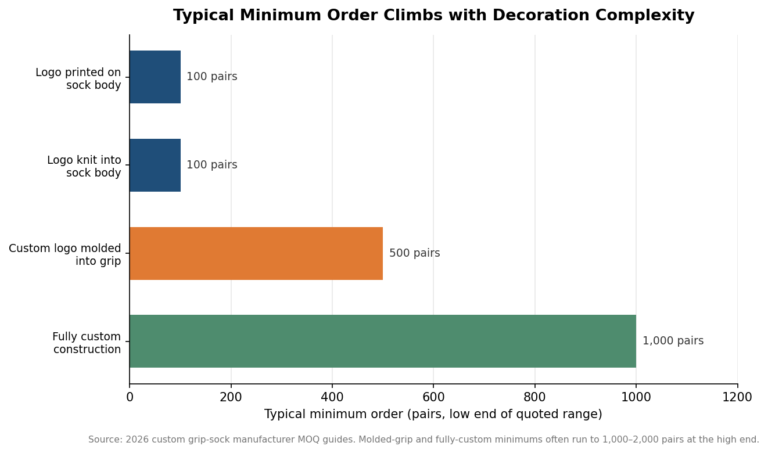
For a studio doing 60-100 client visits per week, a reasonable starter inventory is 50-100 pairs of branded grip socks. That’s about a 6-8 week supply at typical sell-through rates. At Tier 3 wholesale pricing (about $5 per pair landed), the inventory cost is $250-500. With a $25 retail price, the gross margin per pair is $20.
Sell-through to break even is just 12-25 pairs — usually within 2-3 weeks of starting. Everything after that is incremental profit.
When to reorder
The signal to reorder is when you hit about 20 pairs left in stock — roughly 2 weeks of inventory. Reorder at Tier 2 or Tier 1 pricing (250+ pairs) once you’ve confirmed the design works. Most studios are in a reorder cycle every 8-14 weeks.
The data point that matters most isn’t pairs sold — it’s the percentage of clients per week who buy. Once you’re consistently converting 5-8% of weekly client visits into a sock sale, you’re at a sustainable retail rate.
Ready to brand your front-desk rack? Send your studio name and target quantity and we’ll get a mockup back in 24-48 hours.
GET A QUOTEWin Free Stuff
Enter below for a chance to win plus receive 10% off your first order.
🎉 You are in!
Check your email for your 10% off code. Good luck!