Walk into any pilates retail shop and you’ll see two distinct grip-sock patterns: the cheap rubber-dot pattern that’s been on the market for two decades, and the newer continuous-silicone pattern that better studios are switching to. The visual difference is small. The functional difference is significant.
What dotted grip is and where it fails
Traditional grip socks use a regular pattern of small rubber or silicone dots on the bottom of the foot — usually 80-150 small bumps in a uniform grid. The pattern works fine for static balance work and mat-only classes. It fails predictably on the reformer.
The failure mode is rotation. During footwork series, the foot pushes laterally against the carriage edge. A dotted pattern allows the foot to rotate independently of the sock — the dots slip individually because each one is a tiny disconnected contact point. The result is the foot quietly turning out or in within the sock during the press, and the instructor cuing the alignment fix instead of the sock providing it.
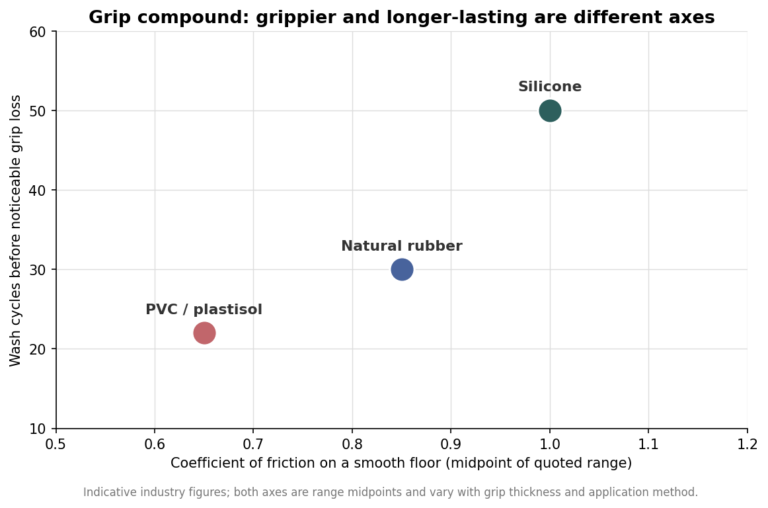
The second failure mode is wear pattern. Dots concentrate force at small points, so they wear off unevenly. After 30-40 client washes, you’ll see specific dots gone from the heel area while the toe dots are intact. Functionally that means inconsistent grip across the foot.
What continuous grip does differently
A continuous silicone grip pattern runs the full sole as a single connected surface — typically with raised ridges or a unified textured field rather than discrete dots. The grip force isn’t divided across hundreds of small contact points; it’s one large surface acting as a unit.
For reformer work, that means the sock and the foot move together. When the foot presses laterally during footwork, the whole sole grips the carriage as one. There’s no within-sock rotation. The carriage feels more responsive because the foot is in direct mechanical communication with it.
For wear, continuous grip distributes force across the whole surface, which means the wear pattern is even and the sock keeps its grip for longer in the high-pressure heel and ball areas.
The studio test
The fastest way to feel the difference is the side-by-side push test. Stand at the reformer with one sock of each type on opposite feet. Do a footwork press with the carriage at light spring tension and notice which foot rotates within its sock and which doesn’t.
The continuous-grip foot stays planted. The dotted-grip foot has a perceptible quarter-turn of slip before the dots all engage. For an experienced instructor, the difference is immediate. For a new client, the difference is the difference between feeling unstable in their first reformer class and feeling confident.
What this means for your studio’s branded sock
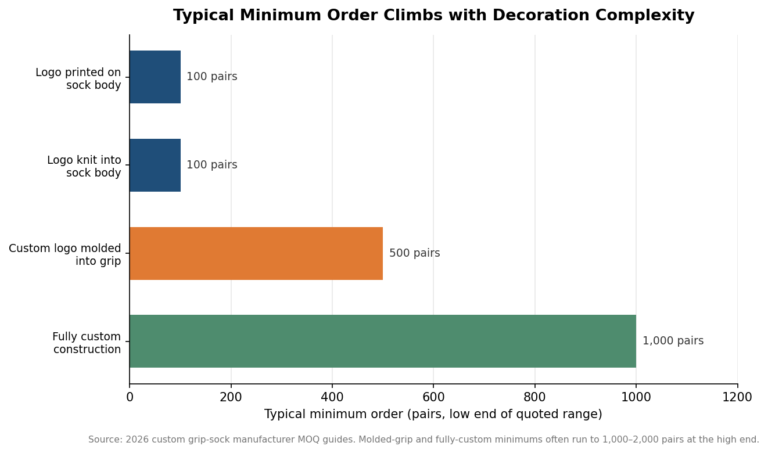
If you’re ordering branded grip socks for your studio’s retail rack, the grip pattern is the spec that matters most. Logo placement, sock color, brand name woven into the ankle band — those are visible and worth getting right. But the grip pattern is the only spec that affects whether clients return for a second pair.
A client who buys a logo-branded dotted-grip sock and finds it slips on the reformer will not buy a second pair. A client who buys a continuous-grip sock and notices her footwork feels more stable will buy a second pair, recommend the sock to a friend, and post about it.
The unit cost difference between dotted and continuous grip at bulk volume is roughly 8-12% — minor on a per-pair basis, significant in terms of long-term sell-through.
What about mat classes?
For mat-only studios and barre classes that don’t involve a sliding surface, dotted grip is functionally adequate. The reformer-specific advantages of continuous grip don’t matter when the foot is on a stable mat. Some studios use a continuous-grip SKU for reformer clients and a dotted-grip SKU for mat clients, split-colored so the front desk can tell them apart.
Other studios just stock the continuous-grip version for everything — it works on the mat too, and the SKU simplification is worth the small cost premium.
The takeaway for studio owners
If your studio is reformer-heavy, the grip pattern is not a place to save money. Continuous silicone grip outperforms dotted grip on the reformer, full stop. The price difference is small. The retention difference on the retail rack is large.
Want to see what a continuous-grip studio sock looks like with your branding on it? Send your logo — we’ll mock it up in 24-48 hours.
GET A QUOTEWin Free Stuff
Enter below for a chance to win plus receive 10% off your first order.
🎉 You are in!
Check your email for your 10% off code. Good luck!