Men’s Grip Socks for Pilates Studios: Sizing & Demand
Men’s Grip Socks for Pilates Studios: Sizing and Demand
Most studios stock grip socks with women in mind, then watch a steady trickle of male clients ask for a pair that actually fits. If you are ordering studio retail, mens grip socks are the easiest inventory gap to close — the demand is real, the sizing is predictable, and a small dedicated size run keeps male reformer and hot-pilates clients from leaving empty-handed.
This guide covers where mens grip socks demand actually comes from, how to build a men’s size run that sells through instead of sitting on the rack, and how to fold men’s pairs into your existing custom order without over-committing cash.
Where men’s demand actually comes from
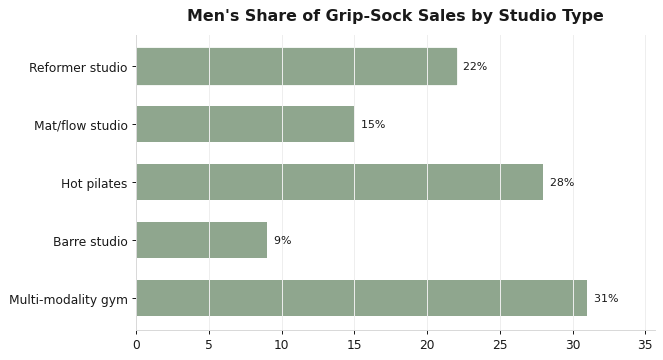
Men’s share of grip-sock sales varies sharply by studio format. Multi-modality gyms and hot-pilates studios see the highest male attendance, and therefore the strongest pull for mens grip socks, while barre skews heavily female. Knowing your format tells you how much men’s inventory to carry.
If you run reformer classes with a meaningful male base, even a modest men’s assortment prevents the awkward ‘we only have women’s’ moment at the front desk — and captures a sale you were otherwise turning away.
Building a men’s size run that sells
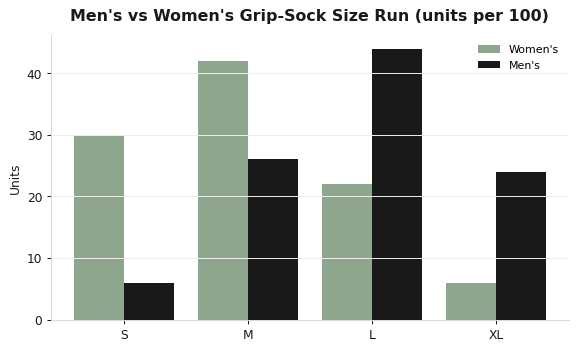
Men’s feet skew larger, so a men’s run should weight toward M–XL, mirroring how a women’s run weights toward S–M. Ordering a men’s assortment with the same size curve as your women’s stock is the classic mistake — you end up with unsold smalls and stock-outs on XL.
Unisex vs dedicated men’s styling
Some studios prefer a single unisex colorway to simplify buying; others carry a distinct men’s palette. Unisex reduces SKUs and reorder complexity, while a dedicated men’s look can lift attachment for male clients who skip anything that reads as women’s product. Either works — just keep the grip pattern and branding consistent with the rest of your merch.
Folding men’s pairs into a custom order
You do not need a separate order. Add men’s sizes to your existing custom grip-sock run so setup and branding costs amortize across both. Start conservative — a quarter to a third of your total units in men’s — then let real sell-through set the ratio for reorders.
| Studio type | Suggested men’s mix | Priority sizes |
|---|---|---|
| Hot pilates / gym | 30–35% of units | L, XL |
| Reformer studio | 20–25% | M, L |
| Barre / mat | 10–15% | M, L |
For help matching specs across formats, see our about us and our companion piece, our Grip Sock Packaging & Unboxing for Studio Retail Sales. When you’re ready, get a studio quote and we’ll build a men’s-inclusive size run for your studio.
Merchandising men’s socks so they actually sell
Stocking mens grip socks is only half the job; presenting them so male clients notice and buy is the other half. Front-desk placement matters: a small dedicated men’s section, or a clearly labeled shelf tag, signals that you carry sizes that fit rather than leaving men to guess whether the display is for them. A neutral or masculine colorway displayed alongside your women’s range removes the hesitation that stops many men from asking.
Staff scripting helps too. A simple prompt at check-in — ‘we carry grip socks in men’s sizes if you need a pair for class’ — converts far more than a silent rack. Because grip socks are often a class requirement for reformer and hot formats, framing them as part of the equipment rather than an upsell makes the purchase feel routine. Bundle options, such as a two-pair starter price, nudge first-timers to buy a spare.
Fit, materials, and durability for men’s feet
Men’s grip socks are not simply larger versions of the women’s product. Broader feet and higher arches change how a sock sits, so a men’s-appropriate last and a slightly wider footbed improve comfort and keep the grip pattern under the ball and heel where it belongs. A blend with enough spandex to hug the arch prevents the sock from rotating during lateral work on the reformer, which is the most common comfort complaint.
Durability expectations differ as well. Men’s clients in high-heat classes sweat more into the sock, so a moisture-wicking cotton or micro-modal blend with reinforced grip dots holds up better wash after wash. Confirm that the grip compound is rated for repeated laundering; a pattern that peels after a month erodes trust in your whole retail program regardless of how good the sock felt on day one.
Reading sell-through and reordering with confidence
Once your first men’s run is on the floor, let the numbers guide the next order. Track which sizes sell out first and which linger; in most studios large and extra-large clear before medium, confirming the larger-weighted curve. Watch reorder velocity by color, too, since a single strong men’s colorway often outsells two mediocre ones. A simple monthly tally at the front desk is enough to sharpen every subsequent order.
Fold men’s reorders into your regular grip-sock buys so setup and branding costs stay amortized across the whole order rather than triggering a separate minimum. Keeping men’s at roughly a quarter to a third of total units until data says otherwise protects cash while ensuring you rarely turn a male client away at the desk.
Common questions about men’s grip socks
Do I really need separate men’s socks, or will unisex work?
Unisex sizing works for many studios and simplifies buying, but it can leave the largest and smallest clients poorly served. If you have a meaningful base of male clients, a dedicated men’s size run in L and XL closes the gap that unisex leaves; if your male attendance is light, a broad unisex range may be enough to start.
What percentage of my grip-sock stock should be men’s?
Start around a quarter to a third of units for most studios, weighted toward larger sizes, then adjust from sell-through. Hot-pilates and multi-modality gyms with higher male attendance can justify more; barre-heavy studios usually need less.
Should men’s socks be a different color from women’s?
A distinct or neutral men’s colorway can lift attachment for male clients who skip anything that reads as women’s product, but it is optional. The essentials are that the grip pattern and branding stay consistent with the rest of your merch so the whole range looks like one system.
Can men’s grip socks be added to my existing custom order?
Yes — adding men’s sizes to your existing custom run keeps setup and branding costs shared across both, which is far more economical than a standalone men’s order. Just specify the men’s size curve so the sock is cut for broader feet rather than scaled up from a women’s last, and confirm the grip layout still lands under the ball and heel on the larger footbed before you approve the run.
Stocking grip socks your whole clientele can wear?
We’ll spec a men’s-inclusive size run and match it to your studio’s branding.
Get a Studio QuoteMen’s Grip Socks for Pilates Studios: Sizing and Demand
Most studios stock grip socks with women in mind, then watch a steady trickle of male clients ask for a pair that actually fits. If you are ordering studio retail, mens grip socks are the easiest inventory gap to close — the demand is real, the sizing is predictable, and a small dedicated size run keeps male reformer and hot-pilates clients from leaving empty-handed.
This guide covers where mens grip socks demand actually comes from, how to build a men’s size run that sells through instead of sitting on the rack, and how to fold men’s pairs into your existing custom order without over-committing cash.
Where men’s demand actually comes from
Men’s share of grip-sock sales varies sharply by studio format. Multi-modality gyms and hot-pilates studios see the highest male attendance, and therefore the strongest pull for mens grip socks, while barre skews heavily female. Knowing your format tells you how much men’s inventory to carry.
If you run reformer classes with a meaningful male base, even a modest men’s assortment prevents the awkward ‘we only have women’s’ moment at the front desk — and captures a sale you were otherwise turning away.
Building a men’s size run that sells
Men’s feet skew larger, so a men’s run should weight toward M–XL, mirroring how a women’s run weights toward S–M. Ordering a men’s assortment with the same size curve as your women’s stock is the classic mistake — you end up with unsold smalls and stock-outs on XL.
Unisex vs dedicated men’s styling
Some studios prefer a single unisex colorway to simplify buying; others carry a distinct men’s palette. Unisex reduces SKUs and reorder complexity, while a dedicated men’s look can lift attachment for male clients who skip anything that reads as women’s product. Either works — just keep the grip pattern and branding consistent with the rest of your merch.
Folding men’s pairs into a custom order
You do not need a separate order. Add men’s sizes to your existing custom grip-sock run so setup and branding costs amortize across both. Start conservative — a quarter to a third of your total units in men’s — then let real sell-through set the ratio for reorders.
| Studio type | Suggested men’s mix | Priority sizes |
|---|---|---|
| Hot pilates / gym | 30–35% of units | L, XL |
| Reformer studio | 20–25% | M, L |
| Barre / mat | 10–15% | M, L |
For help matching specs across formats, see our about us and our companion piece, our Grip Sock Packaging & Unboxing for Studio Retail Sales. When you’re ready, get a studio quote and we’ll build a men’s-inclusive size run for your studio.
Merchandising men’s socks so they actually sell
Stocking mens grip socks is only half the job; presenting them so male clients notice and buy is the other half. Front-desk placement matters: a small dedicated men’s section, or a clearly labeled shelf tag, signals that you carry sizes that fit rather than leaving men to guess whether the display is for them. A neutral or masculine colorway displayed alongside your women’s range removes the hesitation that stops many men from asking.
Staff scripting helps too. A simple prompt at check-in — ‘we carry grip socks in men’s sizes if you need a pair for class’ — converts far more than a silent rack. Because grip socks are often a class requirement for reformer and hot formats, framing them as part of the equipment rather than an upsell makes the purchase feel routine. Bundle options, such as a two-pair starter price, nudge first-timers to buy a spare.
Fit, materials, and durability for men’s feet
Men’s grip socks are not simply larger versions of the women’s product. Broader feet and higher arches change how a sock sits, so a men’s-appropriate last and a slightly wider footbed improve comfort and keep the grip pattern under the ball and heel where it belongs. A blend with enough spandex to hug the arch prevents the sock from rotating during lateral work on the reformer, which is the most common comfort complaint.
Durability expectations differ as well. Men’s clients in high-heat classes sweat more into the sock, so a moisture-wicking cotton or micro-modal blend with reinforced grip dots holds up better wash after wash. Confirm that the grip compound is rated for repeated laundering; a pattern that peels after a month erodes trust in your whole retail program regardless of how good the sock felt on day one.
Reading sell-through and reordering with confidence
Once your first men’s run is on the floor, let the numbers guide the next order. Track which sizes sell out first and which linger; in most studios large and extra-large clear before medium, confirming the larger-weighted curve. Watch reorder velocity by color, too, since a single strong men’s colorway often outsells two mediocre ones. A simple monthly tally at the front desk is enough to sharpen every subsequent order.
Fold men’s reorders into your regular grip-sock buys so setup and branding costs stay amortized across the whole order rather than triggering a separate minimum. Keeping men’s at roughly a quarter to a third of total units until data says otherwise protects cash while ensuring you rarely turn a male client away at the desk.
Common questions about men’s grip socks
Do I really need separate men’s socks, or will unisex work?
Unisex sizing works for many studios and simplifies buying, but it can leave the largest and smallest clients poorly served. If you have a meaningful base of male clients, a dedicated men’s size run in L and XL closes the gap that unisex leaves; if your male attendance is light, a broad unisex range may be enough to start.
What percentage of my grip-sock stock should be men’s?
Start around a quarter to a third of units for most studios, weighted toward larger sizes, then adjust from sell-through. Hot-pilates and multi-modality gyms with higher male attendance can justify more; barre-heavy studios usually need less.
Should men’s socks be a different color from women’s?
A distinct or neutral men’s colorway can lift attachment for male clients who skip anything that reads as women’s product, but it is optional. The essentials are that the grip pattern and branding stay consistent with the rest of your merch so the whole range looks like one system.
Can men’s grip socks be added to my existing custom order?
Yes — adding men’s sizes to your existing custom run keeps setup and branding costs shared across both, which is far more economical than a standalone men’s order. Just specify the men’s size curve so the sock is cut for broader feet rather than scaled up from a women’s last, and confirm the grip layout still lands under the ball and heel on the larger footbed before you approve the run.
Stocking grip socks your whole clientele can wear?
We’ll spec a men’s-inclusive size run and match it to your studio’s branding.
Get a Studio Quote