Hot Pilates Grip Sock Failure Modes: What Studios Need to Know
Hot pilates classes push hot pilates grip socks harder than any other studio environment. Sweat soaks through the sole, grip patterns lose traction, and members slide on reformer carriages or mat work in ways that damage their flow — and your studio’s reputation. This guide breaks down the four most common failure modes, the fiber and grip choices that cause them, and what to spec when ordering branded grip socks for hot pilates programming.
Why hot pilates grip socks fail differently than mat or barre socks
Hot pilates rooms hold ambient temperatures between 95°F and 105°F with humidity above 40%. Members sweat through socks within the first 10-15 minutes of class. That sweat changes how the grip pattern interacts with the equipment — silicone grips become slick against a sweat-saturated mat or carriage, while continuous grip pads hold their performance longer than dotted patterns.
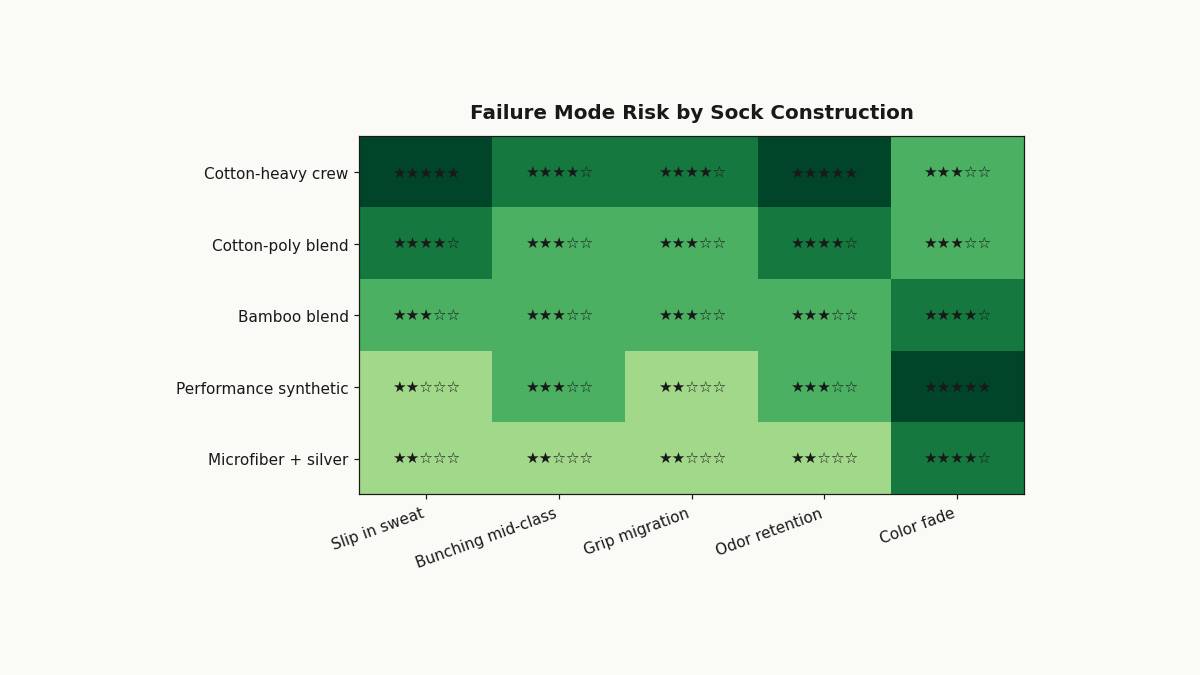
The matrix above scores common sock constructions against five failure modes seen in hot pilates: slip in sweat, bunching mid-class, grip migration, odor retention, and color fade. Cotton-heavy crew socks fail fastest on slip; performance synthetics fade fastest under repeated hot wash cycles.
Slip in sweat — the headline failure
The most visible failure mode is grip loss when the silicone pattern saturates with sweat. Continuous grip pads (a single piece of silicone covering the full sole) retain more dry-state grip than dotted patterns because the contact surface stays consistent even when wet. The tradeoff: continuous pads cost more per pair and slow down moisture evaporation under the foot.
Grip retention under sweat
The chart above plots grip retention after 45 minutes of simulated sweat exposure. Continuous grip pads retain about 88% of dry-state grip. Cross-hatch grip retains 80%. Dotted full-sole grip retains 72%. Lattice retains 76%. Edge-only grip drops to 54% — the right design for warm yoga but a poor fit for hot pilates programming.
Bunching mid-class
Cotton-poly blends absorb sweat into the sock body and lose shape across a 50-minute class. Members feel the sock bunch under the arch or slip down the heel. The fix is a high-stretch performance synthetic with a tight cuff that holds the sock in place even when soaked.
Construction and fiber choices that matter for hot pilates
For hot pilates grip socks, three construction choices outperform the default cotton-poly studio stock:
First, a moisture-wicking polyester or microfiber blend with at least 10% spandex. The spandex keeps the sock shape during wet conditions; the polyester moves sweat off the skin faster than cotton.
Second, a continuous silicone grip pattern instead of dotted. The grip surface stays consistent through sweat.
Third, silver- or copper-treated fiber for odor resistance. Hot pilates classes generate sweat odor that lingers in the sock; antimicrobial treatments extend usable life between washes.
Cost per pair by construction
The chart above plots per-pair pricing at a 250-pair minimum across five constructions. Cotton-heavy socks run $4.20 per pair. Performance synthetic runs $6.40. Silver-treated microfiber runs $7.95 — roughly double cotton-heavy. The premium is real but so is the differentiation against generic studio stock.
Retail pricing implications
If your studio retails grip socks at $18-$22 per pair, the per-pair cost difference between cotton-heavy ($4.20) and silver-treated microfiber ($7.95) is the difference between a 76% margin and a 56% margin. For hot pilates studios where the sock is part of the brand experience, the lower margin on a better-performing sock pays back through reduced returns and stronger member word-of-mouth.
Failure mode prevention checklist
When briefing a manufacturer for hot pilates grip socks, ask for: (1) a continuous silicone grip pattern, (2) a polyester-spandex blend with at least 10% spandex, (3) silver or copper antimicrobial treatment, (4) a 2-inch ribbed cuff to prevent slipping, and (5) reinforced toe and heel construction. The combination addresses all four major failure modes seen in hot pilates classes.
Bulk ordering for hot pilates studios
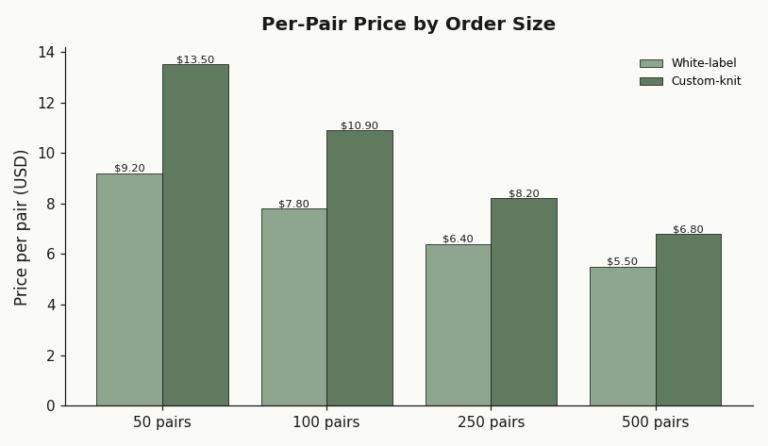
Most hot pilates studios order in 200-500 pair batches every 6-8 weeks. The shorter reorder cadence (vs mat-only studios) reflects faster sock turnover from heavy washing. Lock in a manufacturer who can guarantee consistent fiber blend and grip pattern across reorders — drift in either spec changes the perceived quality from the member’s perspective.
Bottom line
The right hot pilates grip socks use a continuous silicone grip on a moisture-wicking polyester-spandex body with antimicrobial treatment. Pay the per-pair premium for studios where the sock represents brand quality. Avoid cotton-heavy and dotted-grip socks for any hot pilates programming. Order in 200-500 pair batches with consistent specs across reorders.
Need help speccing grip socks for your hot pilates programming? Visit our studio quote page, see how we work with hot pilates and barre studios, or read our companion piece on studio launch inventory planning.
GET A QUOTEWin Free Stuff
Enter below for a chance to win plus receive 10% off your first order.
🎉 You are in!
Check your email for your 10% off code. Good luck!