White-Label vs Custom-Knit Grip Socks for Studios
When a pilates studio decides to put its name on grip socks, the first real fork in the road is whether to buy white label grip socks and add your mark, or invest in custom knit grip socks made from your artwork up. Both routes end with your logo on your clients’ feet, but they differ in cost, minimum order quantity, lead time, and how the branding actually survives a season of hot classes and repeat washing. This guide walks studio owners through the trade-offs so you can pick the right program for your stage of growth, whether you run a single boutique or a multi-location franchise.
What “White Label” and “Custom Knit” Actually Mean
The terms get used loosely, so let’s define them the way a manufacturer does. White label grip socks are finished, in-stock socks produced to a generic spec that you brand after the fact, usually with a printed or heat-pressed logo on the cuff or footbed. Private label pilates socks sit a step up: the same stock body, but with your branding, packaging, and sometimes a woven care label applied as part of the run.
Custom knit grip socks are built differently. The sock is knitted to your specification from the yarn cone forward, which means your logo is knit into the fabric, your studio colors are dyed into the yarn, and the grip pattern, toe style, and cuff height are all yours to choose. The difference matters most where it shows: a knit-in logo is part of the sock, while a printed one sits on top of it.
Cost and Minimum Order Quantity Compared
Price per pair is where most owners start, and it behaves differently across the two routes. White label carries a low minimum order quantity and a low entry price because you are riding on someone else’s production run. Custom knit grip socks cost more per pair at small volumes because the setup, digitizing, and dye work are spread across your order alone, but the per-pair price falls faster as quantity climbs.
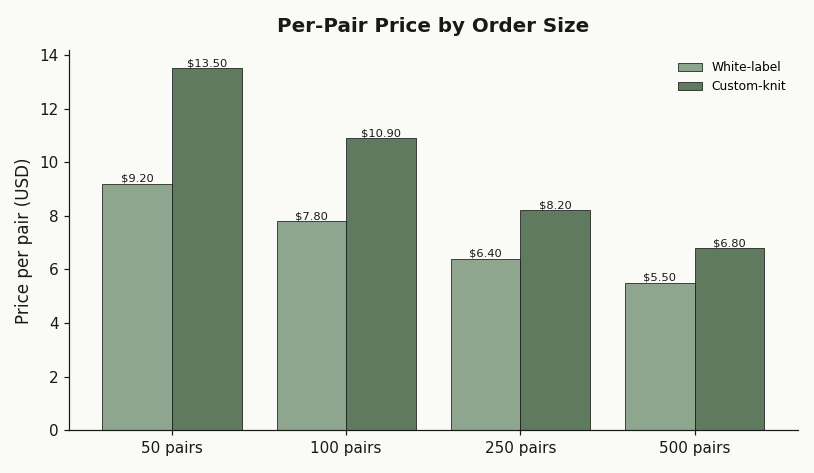
Notice how the two lines converge. At 50 pairs the white label option is dramatically cheaper, which is why it suits a first test or a small new studio launch. By 500 pairs the gap narrows to roughly a dollar a pair, at which point the durability and brand quality of custom knit grip socks usually justify the difference. The minimum order quantity also diverges: white label programs often start around 25 to 50 pairs, while custom knit runs typically begin at 100 to 150 pairs because of the yarn and knit-setup floor.
Hidden Costs Beyond the Per-Pair Price
The sticker price is not the whole story. Printed white label socks carry re-order friction because print colors and placement can drift between suppliers. Custom knit grip socks carry a one-time setup cost, but that spec is then locked and repeatable, so every re-order matches. For a studio building a consistent retail shelf, repeatability has real value. We break down the full retail math in our frequently asked questions.
Knit-In Logo vs Print: How Branding Holds Up
This is the single biggest practical difference, and it is easy to underestimate until a client’s socks come back faded. Printed logos look sharp on day one and photograph beautifully for the launch post. But grip socks live a hard life: hot pilates sweat, frequent hot-water washing, and constant flex under the foot. Over dozens of wash cycles, printed and heat-pressed marks crack, fade, and peel. A knit-in logo, by contrast, is structural, so it holds its shape as long as the sock itself lasts.
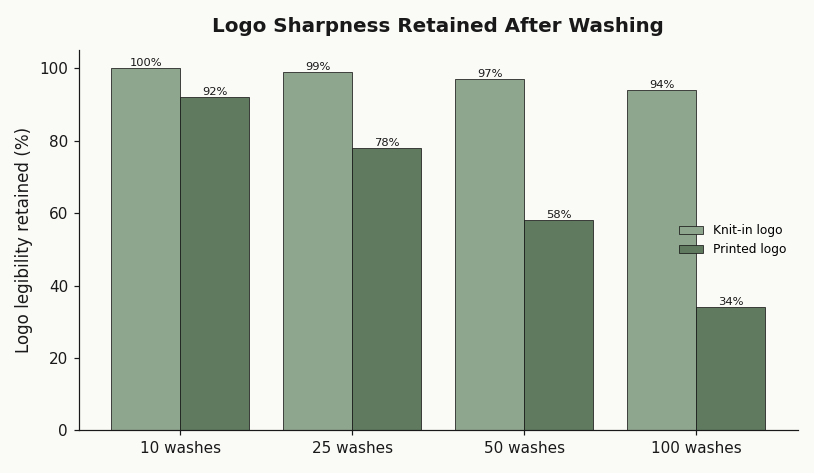
The takeaway for studios is straightforward. If your socks are a giveaway for a one-off event or a short promotion, print is fine and cheaper. If clients will wear your socks two or three times a week for months, and effectively become walking advertising for your brand, a knit-in logo protects your image far longer. Nothing undercuts a premium studio positioning like a client wearing your logo half-peeled off the cuff. For heat-heavy formats this matters even more, which is why we cover it specifically for hot pilates and barre studios.
Which Route Fits Your Studio?
There is no universally correct answer, only the right fit for your volume, timeline, and brand ambitions. The table below maps common studio situations to the route that usually wins.
| Your situation | Better fit | Why |
|---|---|---|
| Testing a branded-sock idea | White label | Low minimum order quantity, low risk, fast start |
| Single studio, steady retail shelf | Custom knit | Repeatable spec, durable branding, better margin at volume |
| Multi-location or franchise | Custom knit | Brand consistency across sites and re-orders |
| One-time event giveaway | White label (printed) | Cheapest per pair for short-term use |
| Instructor or teacher-training gifts | Custom knit | Keepsake quality that reflects your studio |
Growing brands often graduate from one to the other. A studio might launch with private label pilates socks to validate demand, then move to custom knit grip socks once socks prove they sell. If you operate several locations, consistency becomes the deciding factor: we outline procurement for scaled operators on our franchise systems page, and custom knit is almost always the answer there because every location needs identical socks on the shelf.
Don’t Forget the Sock Itself
Branding aside, the two routes can differ in the sock’s core performance. White label bodies are built to a general spec, so grip coverage, toe style, and cuff support are whatever the stock supplier chose. With custom knit grip socks you control those variables: full-foot grip versus a targeted pattern, a closed-toe crew for cooler studios, and a compression cuff that stays put on the reformer. Match the sock to how your clients actually move, not just to how the logo looks.
Style range is another quiet advantage of going custom. A single studio might want an open-toe style for tactile work, a tab-back ankle sock for barre, and a taller crew for hot classes, all in the same brand colorway. White label programs rarely let you mix silhouettes within one order, so you either compromise on fit or run several separate purchases. Custom knit lets you build a small, coordinated range under one spec and one dye lot.
Lead Time and Reordering
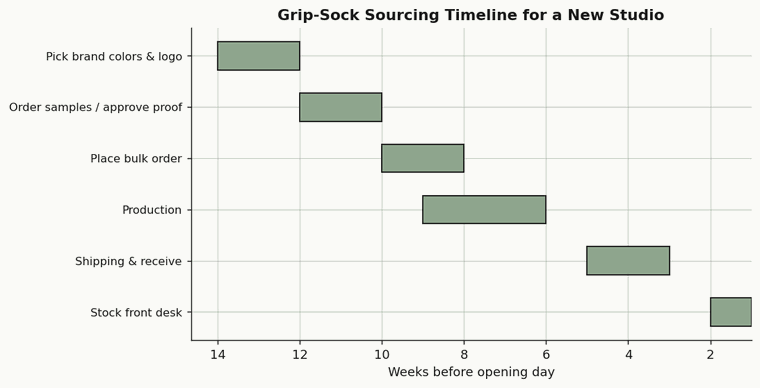
Timeline is the last practical factor. Because white label socks are already made, they ship quickly once your print is set, which is handy for a last-minute launch. Custom knit grip socks need production runway for knitting, dyeing, and a stitched sample approval, so plan several weeks of lead time on a first order. The trade-off is that your locked spec makes every reorder fast and identical, which is exactly what a growing studio wants when it restocks the retail shelf each quarter. Build that first-order runway into your calendar and the ongoing program runs smoothly.
Making the Call
Start by answering three questions. How many pairs will you realistically move in a year? How long will each pair stay in rotation? And how central are branded socks to your studio’s identity? If the answers are “a lot,” “months,” and “very,” custom knit grip socks are the durable, repeatable, brand-safe choice. If you are still testing the water, white label lets you learn cheaply before you commit. Many studios also weigh this against broader kit decisions, which we compare in our companion guide on grip socks and studio liability.
Ready to Compare Options for Your Studio?
Send us your logo, target quantity, and class format, and we’ll return white-label and custom-knit pricing side by side, usually within one business day.
Get a Studio QuoteWin Free Stuff
Enter below for a chance to win plus receive 10% off your first order.
🎉 You are in!
Check your email for your 10% off code. Good luck!